I Found it at the Movies by French Philip;
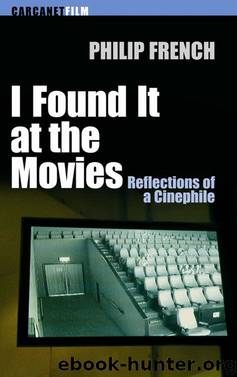
Author:French, Philip; [Philip French]
Language: eng
Format: epub
ISBN: 844613
Publisher: Carcanet
Published: 2011-04-30T04:00:00+00:00
‘Satyajit Ray at 70’ was one of the 66 contributions to Satyajit Ray at 70, a tribute with photographs by Nemai Ghosh and foreword by Henri Cartier-Bresson (Brussels, Eiffel Editions, 1991).
This Is the Special Edition (1991)
Introduction to the festival of 60 newspaper films at the National Film Theatre to celebrate the Observer’s bicentenary.
Journalists turn up in movies from all over the world, but the newspaper movie as an informal genre is essentially the creation of Hollywood after the coming of sound, and pictures made elsewhere about the press are in its shadow. There were movies set in newspaper offices in the silent era, and in the 1920s Hollywood lured some gifted journalists to Hollywood, most notably the former New York Times writer, Herman Mankiewicz, and the veteran of several Chicago dailies, Ben Hecht. Mankiewicz, who was to be the co-author of the greatest newspaper film, Citizen Kane, arrived in Hollywood early in 1926. Later that year he invited Hecht, soon to become the co-author of the greatest of all newspaper comedies, The Front Page, to join him. His telegram read: ‘Will you accept 300 per week to work for Paramount Pictures? All expenses paid. The three hundred is peanuts. Millions are to be grabbed out here and your only competition is idiots. Don’t let it get around.’
With the coming of sound word did get around, and dozens of journalists flocked to a Hollywood in desperate need of people who could produce sharp, speakable dialogue and who knew their way around town. What they knew best was newspapers, and they wrote scripts for hundreds of movies aggrandising, damning or merely exploiting their own profession. In the process they turned journalists and their female counterparts, the so-called sob sisters, into popular heroes and heroines, on a par with cowboys, cops, gangsters, aviators and hoofers. Few of them returned to ill-paid journalism, though one long-forgotten actress went the other way: the B-feature star Elaine Shepard quit Hollywood to become a reporter and even wrote an autobiography called Forgive Us Our Press Passes.
The golden age of the Hollywood newspaper film was from the early 1930s to America’s entry into World War Two, from the first film version of The Front Page (1931), a raucous celebration of cutthroat yellow journalism, to Citizen Kane (1941), a complex examination of how a great newspaper proprietor came to betray his early ideals. Not every Hollywood star appeared in westerns, but at some time or another every star has played a journalist. One recalls Edward G. Robinson as the conscientious editor in Five Star Final (1931), being forced downmarket by his venal proprietors; James Cagney as the crime reporter framed by the mob in Each Dawn I Die (1939); James Stewart as the leftwing reporter reluctantly covering a society wedding in The Philadelphia Story (1940); Spencer Tracy as a sports reporter married to political columnist Katharine Hepburn in Woman of the Year (1942); Fredric March as the journalist exploiting the imminent death of Carole Lombard in Nothing Sacred (1937), the most savage of all satires on unscrupulous newspapermen.
Download
This site does not store any files on its server. We only index and link to content provided by other sites. Please contact the content providers to delete copyright contents if any and email us, we'll remove relevant links or contents immediately.
Still Foolin’ ’Em by Billy Crystal(36453)
Spell It Out by David Crystal(36213)
The Great Music City by Andrea Baker(33269)
Professional Troublemaker by Luvvie Ajayi Jones(29741)
Trainspotting by Irvine Welsh(21943)
Call Me by Your Name by André Aciman(20693)
The Secret History by Donna Tartt(19436)
We're Going to Need More Wine by Gabrielle Union(19155)
Cat's cradle by Kurt Vonnegut(15525)
Ready Player One by Cline Ernest(15109)
Molly's Game by Molly Bloom(14242)
Bombshells: Glamour Girls of a Lifetime by Sullivan Steve(14206)
The Goal (Off-Campus #4) by Elle Kennedy(13939)
Leonardo da Vinci by Walter Isaacson(13471)
4 3 2 1: A Novel by Paul Auster(12597)
The Social Justice Warrior Handbook by Lisa De Pasquale(12283)
The Break by Marian Keyes(9466)
Crazy Rich Asians by Kevin Kwan(9400)
The remains of the day by Kazuo Ishiguro(9189)
